
Transcranial magnetic stimulation (TMS) is one of the best-paid services an outpatient psychiatry practice can offer, and one of the easiest to lose money on. A full course is dozens of sessions, every one of them tied to a prior authorization, a unit limit and a coverage policy that differs by payer. One wrong code on day one, or one missed re-authorization in week six, can leave thousands of dollars in denied claims.
Spravato (esketamine) adds a second layer of complexity: a REMS-controlled drug, two completely different billing pathways, and a drug code that changed on January 1, 2026.
This guide walks through the three TMS CPT codes, how a typical course codes out session by session, what Medicare and commercial payers require before they pay, how to bill Spravato correctly, and the denials we see most often.
Quick answer: Bill 90867 once at the start of a TMS course (cortical mapping, motor threshold and first treatment). Bill 90868 for each routine treatment session after that, and 90869 on any day the motor threshold is re-determined. Report one unit per session — these codes are not time-based, and only one of the three can be billed on the same date. For Spravato, Medicare buy-and-bill claims use G2082 (up to 56 mg) or G2083 (more than 56 mg); most commercial and Medicaid plans use J0013 (1 unit per mg) with E/M codes, but payer rules differ.
TMS and Spravato codes at a glance
| Code | What it describes | How to report |
|---|---|---|
| 90867 | TMS treatment, initial: cortical mapping, motor threshold determination, delivery and management | 1 unit, first session of a course |
| 90868 | TMS treatment, subsequent delivery and management, per session | 1 unit per routine session |
| 90869 | TMS treatment, subsequent motor threshold re-determination with delivery and management | 1 unit, on re-mapping days instead of 90868 |
| 0889T–0892T | Accelerated, functional-connectivity MRI-guided theta-burst stimulation (e.g., SAINT) | Category III; coverage is limited |
| G2082 | Established-patient visit with supervision, up to 56 mg esketamine self-administration, includes 2 hours of observation | Medicare (and some other payers), buy-and-bill |
| G2083 | Same as G2082, more than 56 mg esketamine | Medicare (and some other payers), buy-and-bill |
| J0013 | Esketamine, nasal spray, 1 mg (replaced S0013 on Jan 1, 2026) | Units = mg given (56 mg = 56 units) |
Descriptions are simplified. Use the full CPT and HCPCS descriptors for coding.
Are TMS codes changing in 2027? No. A proposal to replace 90867–90869 with new time-based codes was on the AMA CPT Editorial Panel’s September 2025 agenda, but it was withdrawn, and the panel’s February 2026 meeting did not take up TMS. For 2027, keep billing 90867–90869 as you do today — and watch future CPT cycles, because the code set may still be revised.
How the three TMS CPT codes work
90867: the first session only
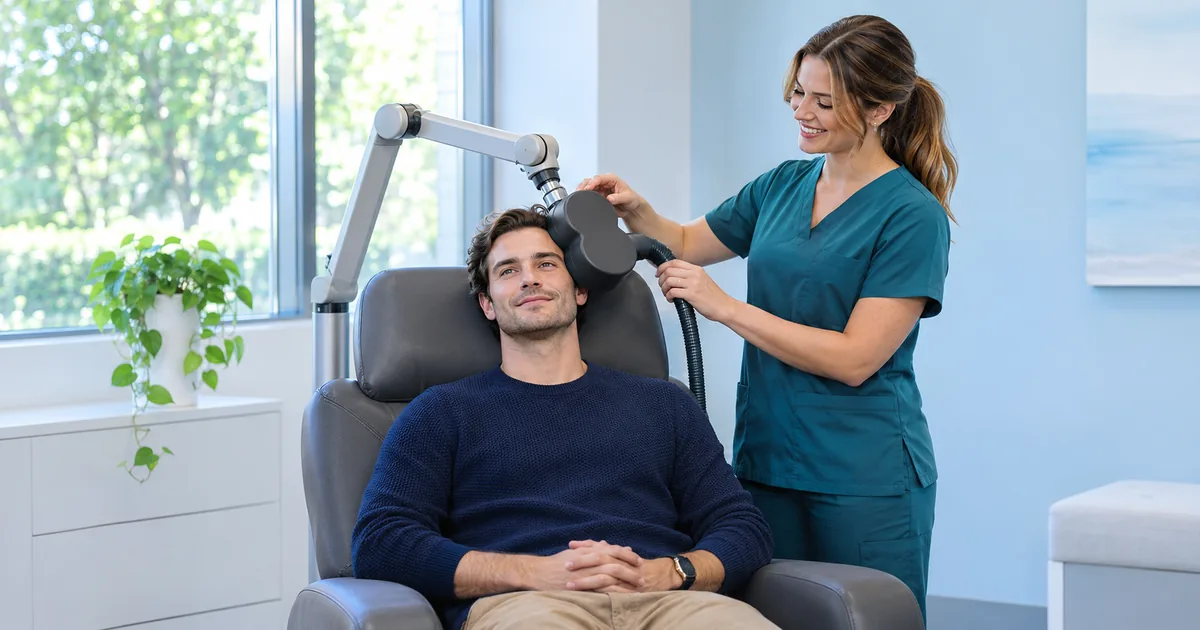
90867 covers the work that starts a course: cortical mapping, finding the patient’s motor threshold, and delivering and managing the first treatment. Report it once per course of treatment. If the patient later starts a new, separately authorized course, many payers allow a new 90867 — confirm that in the authorization.
90868: every routine session after day one
90868 is the workhorse code. Each standard treatment session after the initial one is one unit of 90868, whether the session takes 3 minutes (theta burst) or 37 minutes (standard protocol). The descriptor says “per session,” so never bill multiple units for a longer session.
90869: days when the motor threshold is re-determined
When the clinician re-measures the motor threshold — for example, after a medication change, or on a scheduled weekly or periodic check — and then treats at the new setting, bill 90869 instead of 90868 for that session. Document why the threshold was re-determined and the new value.
The bundling rule that causes most TMS denials
National Correct Coding Initiative (NCCI) edits and CPT instructions don’t allow these codes together on the same date:
- 90867 + 90868 or 90869: not reported together (90867 already includes mapping, threshold and treatment).
- 90869 + 90868: not reported together (90869 already includes delivery and management). If both are billed, the 90868 line denies.
One session, one TMS code.
Coding a typical TMS course, session by session
Payer authorizations commonly follow the standard protocol: daily sessions five days a week for six weeks, then a three-week taper. Here is how that can code out (the number of 90869 units depends on the treating psychiatrist’s protocol and the payer’s limits):
| Phase | Sessions | Codes |
|---|---|---|
| Day 1 | 1 | 90867 × 1 |
| Weeks 1–6 (daily) | 29 | 90868 per session; 90869 on any re-mapping day |
| Weeks 7–9 (taper: 3, 2, 1 sessions) | 6 | 90868 per session |
| Total | 36 | 1 × 90867 + 35 combined 90868/90869 |
Some commercial plans authorize exactly this pattern (for example, 1 unit of 90867, 36 units of 90868 and 1 unit of 90869 for a nine-week course). Others authorize 30 sessions, or require a mid-course re-review. Build the authorized units into your scheduling system so the front desk knows when a patient is running out of approved sessions before the claim denies.
Medicare coverage: what the documentation must show
There is no national coverage determination for TMS. Medicare coverage comes from Local Coverage Determinations (LCDs) written by each Medicare Administrative Contractor (MAC), so the exact criteria depend on where your practice is. Across the current LCDs, the core requirements are similar:
- Diagnosis: a confirmed diagnosis of severe major depressive disorder, single or recurrent episode, in an adult.
- Medication history: treatment resistance in the current episode, shown by failed trials of antidepressants from at least two different classes, or intolerance of multiple agents with distinct side effects. The number of trials differs by MAC — CGS (L36469, Kentucky and Ohio), for example, also accepts intolerance shown by four trials from at least two classes — so read your MAC’s LCD rather than relying on a generic checklist.
- Psychotherapy: a trial of evidence-based psychotherapy of adequate frequency and duration, without significant improvement on a standardized rating scale.
- Order and supervision: the order must come from a psychiatrist (MD or DO) who has examined the patient, reviewed the record and has TMS experience. Treatment must be given under that psychiatrist’s direct supervision; the psychiatrist does not have to deliver every session personally.
- Standardized rating scales: a baseline and follow-up scores (PHQ-9, HAM-D or BDI) to show the need for treatment and the response to it.
Common exclusions in the LCDs include a seizure disorder, psychotic symptoms in the current episode, certain neurological conditions, and implanted magnetic-sensitive devices or metal within 30 cm of the coil.
Retreatment is generally covered only when the patient met the initial criteria, later relapsed, and previously responded with more than 50% improvement on a standard rating scale. Keep the earlier course’s scores on file.
OCD and other indications: Noridian’s LCD (L37086, covering most western states) treats TMS for OCD as not covered, even though some devices are FDA-cleared for OCD. Coverage for OCD, smoking cessation, adolescents or other uses depends entirely on the payer. Verify before you treat.
Commercial payers and prior authorization
Nearly every commercial and Medicaid plan requires prior authorization for TMS, and their criteria are often stricter than Medicare’s. Expect to provide:
- Diagnosis code with severity (for example, F32.2 or F33.2)
- A list of failed antidepressant trials: drug, dose, duration, dates, and why each failed
- Psychotherapy history and dates
- Baseline rating scale scores
- Absence of contraindications
- The treating psychiatrist’s order and treatment plan with the planned number of sessions
Some plans still require four failed medication trials; others accept two. Some send TMS reviews to a behavioral health vendor (for example, Optum or Carelon) rather than the medical plan. Getting these details right before the first session is the single biggest factor in getting a TMS course paid. Our insurance verification and prior authorization team handles this step for TMS practices.
Billing an E/M visit or psychotherapy on a TMS day
The TMS codes include the routine work of delivering and managing the session. A separate service on the same day is billable only when it is significant and separately identifiable:
- E/M or medication management: report the E/M code with modifier 25 when the psychiatrist performs a distinct evaluation (for example, a medication adjustment with its own documentation). A quick check-in during the session is not separate.
- Psychotherapy: when a separate psychotherapy session is performed, some payers expect modifier 59 (or an X modifier) on the psychotherapy code. See our psychotherapy CPT codes guide for the time rules.
- Keep the separate service in its own note, with its own time or medical decision making.
TMS is an in-person service and is not billed as telehealth. Use the place of service where the treatment occurred (POS 11 for an office).
Accelerated TMS (SAINT) and Category III codes
Accelerated, MRI-guided theta-burst protocols such as SAINT have their own Category III codes, 0889T–0892T, effective July 1, 2024. They cover personalized target development from functional MRI, the initial treatment day, subsequent treatment days, and motor threshold re-determination.
Coverage is still limited. Many commercial payers list these codes as unproven or investigational, and in 2026 CMS assigned SAINT a New Technology APC for hospital outpatient payment, which mainly helps hospital-based programs. Before offering accelerated TMS, get written payer confirmation, or use a valid advance beneficiary notice or financial waiver where allowed. Don’t bill standard 90867–90869 codes for an accelerated protocol that has its own codes.
How to bill Spravato (esketamine)
Spravato is FDA-approved for adults with treatment-resistant depression (since January 2025, either alone or with an oral antidepressant) and, with an oral antidepressant, for depressive symptoms in adults with major depressive disorder with acute suicidal ideation or behavior. It can only be given in a REMS-certified healthcare setting, with the patient monitored after each dose.
Two billing pathways
1. Buy-and-bill (your practice buys the drug)
- Medicare: bill G2082 (up to 56 mg) or G2083 (more than 56 mg), one unit per session. These codes bundle the drug, the supervising clinician’s E/M work and the two-hour observation. Don’t add J0013 for the drug.
- Commercial and Medicaid: many plans want J0013 with units equal to the milligrams given (56 or 84 units), plus E/M codes for the visit and monitoring. Others (for example, some Blue plans) expect G2082/G2083 for buy-and-bill. Follow each plan’s written policy.
2. Pharmacy-supplied (a specialty pharmacy dispenses the drug)
- The pharmacy bills for the drug. Your practice bills only the administration and monitoring visit, usually with E/M codes. Because you didn’t supply the drug, don’t bill G2082/G2083 or J0013.
Spravato billing rules to remember
- G2082/G2083 are established-patient codes. For a new patient’s first visit, bill the appropriate E/M visit instead and confirm the payer’s process.
- Don’t bill the observation time as prolonged services. Noridian has specifically flagged G2212 billed for esketamine observation as an error, because the two-hour observation is already in G2082/G2083.
- Don’t combine G2082/G2083 with J0013 (or the old S0013) for the same dose. Several Medicaid programs deny these claims outright.
- Stop using S0013. It was deleted on December 31, 2025. Claims for 2026 dates of service need J0013 where a drug code is required — except where a payer’s system still asks otherwise, which you should confirm in writing.
- Document every session: dose (mg), time of self-administration, vital signs and monitoring, the time monitoring ended, and the patient’s discharge status. The REMS program also has its own patient monitoring form, and FDA approved REMS modifications in 2026 — check the current requirements on the Spravato REMS website.
- Prior authorization is almost universal, with dose and frequency limits (induction twice weekly, then weekly or every two weeks).
The 8 most common TMS and Spravato billing errors
- Billing 90867 more than once in a course, or on a day that should be 90868.
- Billing 90868 and 90869 on the same date.
- Billing more than one unit of a TMS code for a long session.
- Running past the authorized units because nobody tracked them.
- Weak medical necessity: missing medication trial details, no psychotherapy history, or no rating scale scores.
- E/M on every TMS day without modifier 25 or without a separate note.
- Spravato claims on the wrong pathway: G-codes for pharmacy-supplied drug, or J0013 billed on top of G2082/G2083.
- Billing S0013 for 2026 dates of service.
Most of these are prevented at intake and scheduling, not at claim submission. If your TMS or Spravato program has a growing AR or recurring denials, our mental and behavioral health billing team can review a sample of your recent claims.
Frequently asked questions
What is the CPT code for TMS therapy?
TMS is billed with three CPT codes: 90867 for the initial session (mapping, motor threshold and treatment), 90868 for each subsequent treatment session, and 90869 for sessions that include motor threshold re-determination.
Can 90868 and 90869 be billed on the same day?
No. 90869 already includes delivery and management of the treatment, so it replaces 90868 on that date. If both are billed, the 90868 line is denied under NCCI edits.
Is TMS billed per minute?
No. The TMS codes are not time-based. Report one unit per session, regardless of whether the protocol lasts a few minutes or more than half an hour.
How many TMS sessions will insurance cover?
A common authorization is 36 sessions: 30 daily sessions over six weeks plus a six-session taper over three weeks. Limits vary by payer, and some approve fewer sessions or require a mid-course review.
Does Medicare cover TMS?
Yes, for adults with severe major depressive disorder who meet the medication-resistance, psychotherapy and supervision criteria in their MAC’s Local Coverage Determination. Coverage for OCD and other conditions is limited or not covered, depending on the MAC.
What codes are used to bill Spravato?
For Medicare buy-and-bill, G2082 (up to 56 mg) or G2083 (more than 56 mg), which include the drug and two hours of observation. Many commercial and Medicaid plans use J0013, billed per mg, with E/M codes. When a pharmacy supplies the drug, the practice bills only the visit.
What replaced HCPCS code S0013?
J0013 (esketamine, nasal spray, 1 mg) replaced S0013 on January 1, 2026. S0013 was deleted on December 31, 2025.
Keep every TMS session paid
TMS and Spravato reward practices that are precise from intake onward: the right authorization, the right number of units, the right code for each session, and notes that prove medical necessity. Medbilling Edge works with psychiatric practices and TMS clinics across the U.S. on prior authorization, credentialing, coding, claim submission, denial management and AR follow-up, with a certified billing team and a dedicated contact for your practice.
Request a free TMS billing review →
This article is for general education and reflects CPT, HCPCS, Medicare and FDA information available as of November 2026. Coverage policies and payer rules vary and change; always verify current requirements with the specific payer and your MAC. CPT® is a registered trademark of the American Medical Association.